
Sub-Total: $0.00
Do I Bond or Reconstruct
What is the difference between hair Bonders and Reconstructors
Bond builders mainly repair internal chemical bonds (especially disulfide bonds) inside the cortex, while reconstructors mainly replenish and reorganize structural proteins and amino acids to rebuild the hair’s protein matrix.
What bonders (bond builders) do
- Target internal bonds such as disulfide, hydrogen, and ionic bonds that give hair its strength and shape.
- Use small actives (for example bis-aminopropyl diglycol dimaleate, maleic acid derivatives, gluconamides) that penetrate and re-link or reinforce broken bonds from chemical services like bleach, color, perms, relaxers.
- Work mostly at the molecular/cortical level to improve integrity, elasticity, and resistance to future damage, with less emphasis on coating or adding bulk protein to the cuticle.
- Example indications: repeatedly lightened hair, compromised curls after chemical services, extreme breakage where the internal bonds are heavily disrupted.
What reconstructors do
- Are intensive protein-based treatments designed to rebuild the hair’s internal protein structure and fill weak areas along the shaft.
- Typically contain blends of hydrolyzed keratin, amino acids, and strengthening nutrients that penetrate into the cortex and also reinforce the cuticle surface.
- Form a temporary “protein matrix” that helps porous hair hold color better, reduces breakage, and restores elasticity, but can lead to stiffness if overused.
- Example indications: mushy, stretchy, over-moisturized hair, porous hair that won’t hold color, moderate chemical or heat damage needing structural bulk rather than just bond relinking.
How to decide which to use
- Choose a bond builder when you are dealing with significant bond disruption from bleach, high-lift color, perms, or relaxers, especially if hair is snapping with minimal stretch and feels “hollow.”
- Choose a reconstructor when hair feels gummy/stretchy when wet, very porous, or is not holding color, indicating protein loss and structural thinning rather than just bond breakage.
- In many cases, they can be combined in a regimen (for example, bond builder during/after chemical service, then periodic reconstructor for protein plus ongoing moisture care), with attention to not overloading protein and always following with hydration/emollients.
Is there any science demonstrating that bonders do as they claim
There is emerging but still limited science showing that some bond-building actives can improve hair’s mechanical properties and interact with disulfide bonds, but the evidence is not yet huge or independent for every commercial product.
What has been shown in studies
- Laboratory work on new “bond repair” molecules has found significant improvements in tensile strength and elasticity of damaged hair fibers after treatment, compared with untreated controls.
- These studies also use cysteine-reactivity tests and Raman or related spectroscopy to show that certain actives can help re-establish disulfide bridges or alter their conformation in damaged keratin.
- Older work on organic acids binding to hair proteins (the conceptual basis for some modern bonders) shows that acids can interact with keratin via ionic and hydrogen bonds and change hair-set durability.
Evidence specific to popular actives
- Bis-aminopropyl diglycol dimaleate has been characterized chemically, and in vitro tests suggest it can interact with sulfur atoms to form an “extended” disulfide-like bridge, theoretically reinforcing damaged bonds.
- Trade and review articles in cosmetic science describe this molecule as intercalating between broken disulfide bonds and forming a protective crosslink, which correlates with reduced breakage in mechanical testing.
- Clinical or consumer trials for some newer bond-repair lines report improved hair feel and reduced signs of damage, but these are usually small, brand-sponsored studies and focus on cosmetic outcomes, not just pure bond counts.
Where the science is still weak or debated
- Independent, peer‑reviewed clinical trials directly on branded “bond builder” systems (large sample sizes, long term, with proper controls) are still sparse; most data are lab-based fiber studies or in-house testing.
- Some critical reviews and discussions point out that not all experiments show clear new disulfide formation, and a few analyses question whether certain molecules truly “repair” bonds versus coating/patching damaged areas and improving feel and strength indirectly.
- Because many publications are marketing-adjacent (brand white papers, sponsored articles, PR), there is a gap between mechanistic plausibility, in vitro data, and strong independent confirmation for every claim on the box.
Practical takeaway for you
- There is credible mechanistic and lab evidence that certain bond-building actives interact with keratin and can measurably improve strength and elasticity of damaged hair fibers.
- However, claims like “rebuilds all broken bonds” or “returns hair to virgin state” are overstated; the current science supports partial reinforcement and improved performance, not true full restoration.
- When evaluating a specific bonder, look for: named active(s) with published chemistry, any disclosed tensile-strength data on bleached hair versus controls, and whether results come from peer‑reviewed or at least detailed technical reports rather than only marketing copy.
Is there any science backing reconstructor claims
Yes. There is substantially more and longer‑standing science behind protein/reconstructor claims than there is for bond builders, especially for hydrolyzed keratin and related proteins.
What the studies show
- Ex vivo and in vitro studies consistently find that hydrolyzed keratin and other hydrolyzed proteins can increase tensile strength, plateau load, and Young’s modulus of chemically or UV‑damaged hair fibers, sometimes restoring a large fraction of lost strength.
- One recent paper showed that hydrolyzed keratin formed a protective film, reduced UV‑induced cuticle erosion, and actually improved tensile properties after UV exposure compared with untreated hair.
- Another study using intact keratin K31 on bleached hair found up to 49% increases in fiber diameter and almost 2‑fold increases in mechanical strength after a single treatment, indicating real structural reinforcement rather than just cosmetic coating.
Mechanism evidence (how reconstructors work)
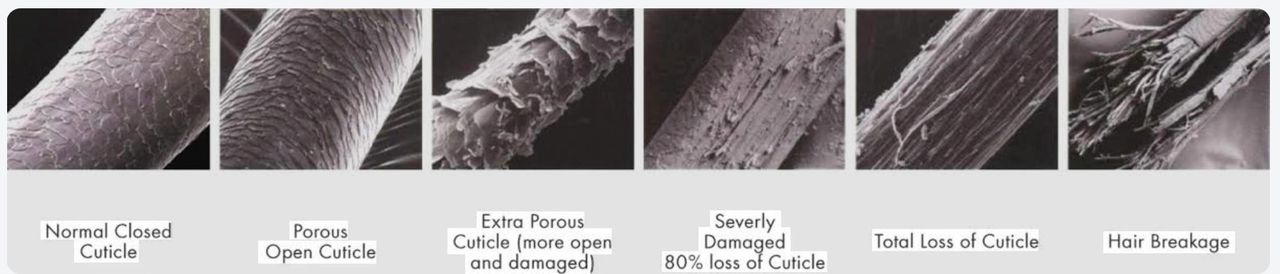
- Microscopy (SEM) and spectroscopy in these studies show protein films on the cuticle and partial penetration into the cortex, filling gaps and reinforcing weak zones.
- Work comparing different molecular‑weight keratin peptides demonstrates that mid‑range keratin peptides penetrate the cortex and significantly improve break stress and reduce premature fractures, while very low‑MW peptides mostly increase diameter without much stabilizing effect.
- Overall, this supports the classic reconstructor model: hydrolyzed keratin and similar proteins deposit on the surface, partially penetrate, interact with existing keratin (including via disulfide and weaker bonds), and measurably increase strength and resilience.
How this maps to salon “reconstructor” claims
- Common marketing claims like “strengthens hair,” “reduces breakage,” and “improves elasticity of damaged hair” are broadly supported by independent tensile and breakage data on hydrolyzed keratin and other hydrolyzed proteins.
- What is not fully proven for every branded reconstructor is the exact magnitude a specific product achieves in real‑world salon use, since most rigorous work tests defined protein actives under controlled lab conditions rather than finished formulas.
Practical interpretation for you
- From a scientific standpoint, “protein reconstructor” as a category is well‑founded: hydrolyzed keratin and related proteins can genuinely reinforce damaged hair fibers and improve measurable mechanical properties.
- As with bonders, individual brand claims still deserve scrutiny (concentration, MW range, formulation), but you can feel more comfortable that the underlying mechanism and outcome (stronger, less breakage‑prone hair) are backed by decades of cosmetic science.
- Product Suggestion
- Enjoy- Instant Reconstrucing Spray (IRS) – on justed washed hair spray through then
- Enjoy – Instant Reconstructor – onto of IRS
- Colure- Repairative Spray first then put Colure on top
